











11/2/2026 4:00:00 PM | Football
It's Rankings SZN!
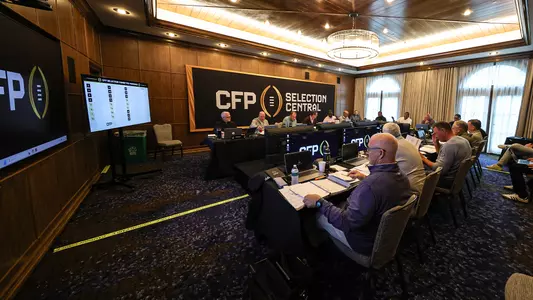
Beginning November 2 and continuing over the next five weeks, the CFP Selection Committee will meet, discuss, evaluate and rank the top 25 teams in college football every week. Then on Selection Day (Sunday, Dec. 6) the Selection Committee will set the 12-team bracket.
Here is everything you need to know about who they are, what they do and exactly how they vote.
Who is on the committee
The CFP Selection Committee is an innovative, leading group of college football experts, equipped with some of the most sophisticated data and analytics tools in sports. The data informs the discussion, and the group's experience drives the decisions.
Its 13 members include six sitting athletics directors, four former head coaches, two former All-American football players and a longtime sportswriter, giving the room a wide range of viewpoints.
Members are picked by the CFP Management Committee based on their deep knowledge of college football, passion for the game and overall integrity.
Members serve three-year terms. They are not paid; the CFP only covers their travel and technology expenses. They are not expected to attend games in person and instead watch live TV broadcasts and condensed game replays through custom viewing tools.
What the committee does
The committee has one mission: rank the best teams and build the playoff bracket.
In practice, that job has four parts:
The chair runs the meetings and serves as a public spokesperson alongside CFP Executive Director Rich Clark, explaining the rankings after each release.
How the field is built
The ranking feeds a 12-team field built under the following guidelines:
How the CFP Selection Committee evaluates teams: A team's full profile, not any single metric
The Selection Committee evaluates teams on a comprehensive body of work, not by any single metric. Rankings are determined by comparing the full profile of teams.
The Committee utilizes three sources to measure a team's performance: video, data (via a customized portal) and conference input. It is a rigorous process, as fans would expect.
When teams look comparable, members apply the following four principles:
For data, the CFP uses SportSource Analytics, a platform that lets members compare teams on nearly any measure. Members also watch a large volume of video, using technology resources that allow them to watch condensed versions of games that feature game action only with advanced replay and viewing features.
Two members are assigned as "point persons" for each conference and for the independents. They gather facts from conference offices on video calls during the season, but they are strictly fact-finders, never advocates. Outside those calls, there is no contact between point persons and conference staff.
Teams, not conferences
The Selection Committee primarily evaluates teams, not conferences. However, conference strength is considered as part of the Committee's overall evaluation and provides important context for assessing a team's body of work.
That consideration is informed by the quality of the competition a team faces, the results it produces against that competition, and measures including Opponent Team Strength, Schedule Strength and Record Strength.
New for 2026-27, there is a Strength of Conference Enhancement, which is an enhancement, not a new metric. A similar measure has been available to the committee in the past; this season it's presented with greater emphasis on differences in schedule strength within a single conference. Strength of schedule, head-to-head results and common opponents remain as important as ever.
The voting process
The top 25 is built from the top down in seven rounds* of confidential voting. Each of the seven round has two parts: a "listing step" and a "ranking step." Members discuss and evaluate the teams in depth between every step. Here is how it plays out in Selection Central:
*Here is how the seven rounds break down:
Round One: Focus on ranking the top four teams, who will receive first-round byes.
Round Two: Focus on ranking teams five through eight, who will host home games.
Round Three: Focus on ranking teams nine through 12, who will become the four visiting teams in the Playoff. (If a team outside the Top 12 is an automatic qualifier, one of these teams will be replaced.)
Round Four: Focus on ranking teams 13 through 16, who will become the final teams outside the Playoff.
Round Five and Six: Focus on ranking teams 17–19 and 20–22.
Round Seven: Focus on ranking teams 23–25, who will become the final three teams in the rankings.
^The "best score" is on a points system. The best team in each member's ranking will receive one point; second-best, two points, etc. The members' rankings will be added together and the four teams receiving the fewest points will become the top four ranked teams.
Recusals and integrity safeguards
No member votes on a team they have a stake in. Because six sitting athletics directors serve on the committee, the recusal policy is central to credibility and fairness.
The rules also reach into the ballot itself: a recused member cannot list the team in the listing step or rank any pool that includes it.
Key dates for 2026
Six rankings releases lead to the bracket, and only the last one counts. Games played after Selection Day are not considered. All rankings will be shown on ESPN.
From there, first-round games kick off Dec. 18–19 on campus, and the road ends at the CFP National Championship in Las Vegas on Jan. 25, 2027.
Beginning November 2 and continuing over the next five weeks, the CFP Selection Committee will meet, discuss, evaluate and rank the top 25 teams in college football every week. Then on Selection Day (Sunday, Dec. 6) the Selection Committee will set the 12-team bracket.
Here is everything you need to know about who they are, what they do and exactly how they vote.
Who is on the committee
The CFP Selection Committee is an innovative, leading group of college football experts, equipped with some of the most sophisticated data and analytics tools in sports. The data informs the discussion, and the group's experience drives the decisions.
Its 13 members include six sitting athletics directors, four former head coaches, two former All-American football players and a longtime sportswriter, giving the room a wide range of viewpoints.
Members are picked by the CFP Management Committee based on their deep knowledge of college football, passion for the game and overall integrity.
| SELECTION COMMITTEE MEMBER | BACKGROUND |
|---|---|
| Hunter Yurachek (chair) | Athletics director, Arkansas |
| Troy Dannen | Athletics director, Nebraska |
| Mark Dantonio | Former head coach, Cincinnati and Michigan State |
| Doug Gillin | Athletics director, Appalachian State |
| Mark Harlan | Athletics director, Utah |
| Ivan Maisel | Former sportswriter (Sports Illustrated, Dallas Morning News, ESPN, On3) |
| Gus Malzahn | Former head coach, Arkansas State, Auburn and UCF |
| Chris Massaro | Athletics director, Middle Tennessee State |
| Randall McDaniel | Former All-American offensive lineman, Arizona State |
| Mike Riley | Former head coach, Oregon State and Nebraska |
| Jeff Tedford | Former head coach, California and Fresno State |
| Wesley Walls | Former All-American tight end, Ole Miss |
| Carla Williams | Athletics director, Virginia |
Members serve three-year terms. They are not paid; the CFP only covers their travel and technology expenses. They are not expected to attend games in person and instead watch live TV broadcasts and condensed game replays through custom viewing tools.
What the committee does
The committee has one mission: rank the best teams and build the playoff bracket.
In practice, that job has four parts:
- Weekly rankings. Starting in early November, members meet in person every Monday and Tuesday and create a fresh top 25 ranking each week. These rankings show fans and teams how the Committee views the top 25 each week.
- Selection weekend. The committee meets again Friday through Sunday of conference championship weekend, watches the games, evaluates teams and produces its final top 25. This year, Selection Day is Sunday, December 6.
- Seeding the field. The final rankings decide the 12-team bracket, including which four teams earn first-round byes and which four host first-round games on campus.
- Bowl assignments. New this season, the top 3 seeds will choose their bowl path, in rank order. CFP Quarterfinal bowls include the Cotton Bowl, Fiesta Bowl, Peach Bowl, and Rose Bowl. CFP Semifinal bowls include the Orange Bowl and Sugar Bowl.
The chair runs the meetings and serves as a public spokesperson alongside CFP Executive Director Rich Clark, explaining the rankings after each release.
How the field is built
The ranking feeds a 12-team field built under the following guidelines:
- The conference champions from the ACC, Big Ten, Big 12 and SEC get in automatically.
- The highest ranked team from among the American, Conference USA, MAC, Mountain West, Pac-12, and Sun Belt Conferences gets in automatically.
- The next seven highest-ranked teams fill out the field as at-large selections.
- Notre Dame makes it if it finishes in the committee's top 12.
How the CFP Selection Committee evaluates teams: A team's full profile, not any single metric
The Selection Committee evaluates teams on a comprehensive body of work, not by any single metric. Rankings are determined by comparing the full profile of teams.
The Committee utilizes three sources to measure a team's performance: video, data (via a customized portal) and conference input. It is a rigorous process, as fans would expect.
When teams look comparable, members apply the following four principles:
- Strength of schedule: who a team played, not just whether it won.
- Head-to-head results: if two teams met, that result carries additional consideration.
- Results against common opponents: how each fared against shared opponents, without rewarding running up the score.
- Other relevant factors: such as injuries to key players or unavailability of a coach that affected a team's season or will affect its postseason.
For data, the CFP uses SportSource Analytics, a platform that lets members compare teams on nearly any measure. Members also watch a large volume of video, using technology resources that allow them to watch condensed versions of games that feature game action only with advanced replay and viewing features.
Two members are assigned as "point persons" for each conference and for the independents. They gather facts from conference offices on video calls during the season, but they are strictly fact-finders, never advocates. Outside those calls, there is no contact between point persons and conference staff.
Teams, not conferences
The Selection Committee primarily evaluates teams, not conferences. However, conference strength is considered as part of the Committee's overall evaluation and provides important context for assessing a team's body of work.
That consideration is informed by the quality of the competition a team faces, the results it produces against that competition, and measures including Opponent Team Strength, Schedule Strength and Record Strength.
New for 2026-27, there is a Strength of Conference Enhancement, which is an enhancement, not a new metric. A similar measure has been available to the committee in the past; this season it's presented with greater emphasis on differences in schedule strength within a single conference. Strength of schedule, head-to-head results and common opponents remain as important as ever.
The voting process
The top 25 is built from the top down in seven rounds* of confidential voting. Each of the seven round has two parts: a "listing step" and a "ranking step." Members discuss and evaluate the teams in depth between every step. Here is how it plays out in Selection Central:
- Build the pool. Each member lists the 30 teams they consider the best in the country, in any order. Any team named by at least three members stays in consideration for the entirety of that week's meeting.
- Listing step. In the listing step, each member lists their top six teams from the pool of available teams. A team is considered "available" for the listing step if it is not yet placed in that week's rankings. The six teams with the most votes form the pool for the round.
- Ranking step. After lengthy conversation and debate among the group, each member ranks those six teams 1 through 6. The four teams with the best score^ are locked in as the next four in that week's rankings.
- Carry over. With four of the six teams now ranked during the Ranking Step, the other two teams carry over into the next round of voting. Members then list their next six top remaining teams, and the top four vote-getters join the two holdovers to form the next pool of teams.
- Repeat. Steps 3 and 4 run for four rounds, until 16 teams are ranked.
- Finish the top 25. For the last three rounds, only three teams are locked in per round instead of four, completing spots 17 through 25.
*Here is how the seven rounds break down:
Round One: Focus on ranking the top four teams, who will receive first-round byes.
Round Two: Focus on ranking teams five through eight, who will host home games.
Round Three: Focus on ranking teams nine through 12, who will become the four visiting teams in the Playoff. (If a team outside the Top 12 is an automatic qualifier, one of these teams will be replaced.)
Round Four: Focus on ranking teams 13 through 16, who will become the final teams outside the Playoff.
Round Five and Six: Focus on ranking teams 17–19 and 20–22.
Round Seven: Focus on ranking teams 23–25, who will become the final three teams in the rankings.
^The "best score" is on a points system. The best team in each member's ranking will receive one point; second-best, two points, etc. The members' rankings will be added together and the four teams receiving the fewest points will become the top four ranked teams.
Recusals and integrity safeguards
No member votes on a team they have a stake in. Because six sitting athletics directors serve on the committee, the recusal policy is central to credibility and fairness.
- Full recusal applies when a member is paid by a school, or has an immediate family member who plays football, coaches football or works in senior administration there. A fully recused member cannot vote on that team and must leave the room when it is discussed. They may still answer factual questions about the school.
- Partial recusal applies to looser ties, such as a family member employed elsewhere at the university. That member can stay in the room but cannot take part in discussion or voting on the team.
- Discretionary recusals can be added by the CFP executive director when an unpaid tie could look like a conflict.
The rules also reach into the ballot itself: a recused member cannot list the team in the listing step or rank any pool that includes it.
Key dates for 2026
Six rankings releases lead to the bracket, and only the last one counts. Games played after Selection Day are not considered. All rankings will be shown on ESPN.
| DATE | RELEASE | TIME |
|---|---|---|
| Tuesday, November 3 | First rankings | 7-8 p.m. ET |
| Tuesday, November 10 | Rankings #2 | 9-9:30 p.m. ET |
| Tuesday, November 17 | Rankings #3 | 9-9:30 p.m. ET |
| Tuesday, November 24 | Rankings #4 | 7:30-8 p.m. ET |
| Tuesday, December 1 | Rankings #5 | 7-7:30 p.m. ET |
| Sunday, December 6 | Selection Day: final rankings and bracket | Noon - 3 p.m. ET |
From there, first-round games kick off Dec. 18–19 on campus, and the road ends at the CFP National Championship in Las Vegas on Jan. 25, 2027.


Sunday, November 01
Wednesday, October 28
Wednesday, October 21
Wednesday, October 14